Por una buena razón, las aves son emblemáticas de la mañana (cuando muchas son más vocales), pero algunas especies encuentran su voz después del anochecer, y escuchar a estas aves piar por la noche puede ser una experiencia única y encantadora (o misteriosa).
¿Por qué cantan las aves de noche? Algunas especies, como el chotacabras oriental, son nocturnas y solo se comunican al anochecer, ya que es cuando están despiertas. Otras, como los sinsontes norteños, suelen ser activas durante el día, pero vocalizan durante la noche cuando buscan pareja. En ambos casos, la noche ofrece ventajas. Los sonidos ambientales son mínimos y hay menos competencia, al menos vocal, con otras aves.
Aun así, hay demasiadas aves que cantan de noche, o al menos hasta altas horas de la noche, como para enumerarlas aquí. En su lugar, hemos combinado los clásicos sonidos nocturnos de las aves con algunas melodías nocturnas menos conocidas, pero no menos inspiradoras, para crear una lista de reproducción con los cantos nocturnos de aves más cautivadores de Norteamérica. ¡Disfrútenla!
Chotacabras oriental

Chotacabras oriental. Foto de Frode Jacobsen
Technically speaking, the Eastern Whip-poor-will is not a songbird, yet its fabled call, which inspired its name, has enchanted generations. Breeding males repeat their songs deep into spring and early summer nights within the bird’s remaining eastern U.S. range.
Hábilmente camufladas, estas aves nocturnas se escuchan con más frecuencia que se ven. Pero incluso eso se ha vuelto más difícil en los últimos años. Aunque todavía se consideran comunes en algunas regiones boscosas, las poblaciones de chotacabras orientales han disminuido un 75 % en los últimos 50 años, y la especie se ha añadido a la lista. Estado de las aves de América del Norte Watch List. The cause? Collisions with autos and insect declines may play a role, but the loss of forests to agriculture and development is likely the main driver.
ABC y sus socios están trabajando para ayudar a abordar el problema declive de los insectívoros aéreos including whip-poor-wills. Our Migratory Bird Program also aims to address the reasons for decline of whip-poor-wills and many other birds throughout their life cycles.
Chotacabras oriental (Doug Welch, XC469348. Accesible en www.xeno-canto.org/469348.)
Charla de pecho amarillo
Chara pechiamarilla. Foto de Punkbirdr/Shutterstock
El Charla de pecho amarillo‘s “song” is a weird and wonderful mix of cackles, clucks, whistles, and hoots. Although not nocturnal, these birds do sing at night, especially in their springtime breeding season. Frustrated birders sometimes compare the vocalizations of concealed chats to mocking laughter.
Like so many other bird species, chats are threatened by habitat loss. Over the last 50 years, their population has declined by 37 percent. As a result, the species is now listed as threatened, endangered, or of special concern in several states.
Los cataratas pechiamarillas se benefician de los esfuerzos de forestación gestionada por ABC y sus socios, incluido el Iniciativa de Silvicultura Sostenible, that create and preserve semi-open habitat. Several habitat management projects designed to aid rapidly declining Reinitas alidoradas also benefit Yellow-breasted Chats.
Charla de pecho amarillo (Paul Marvin, XC486580. Accesible en www.xeno-canto.org/486580.)
Búho barrado

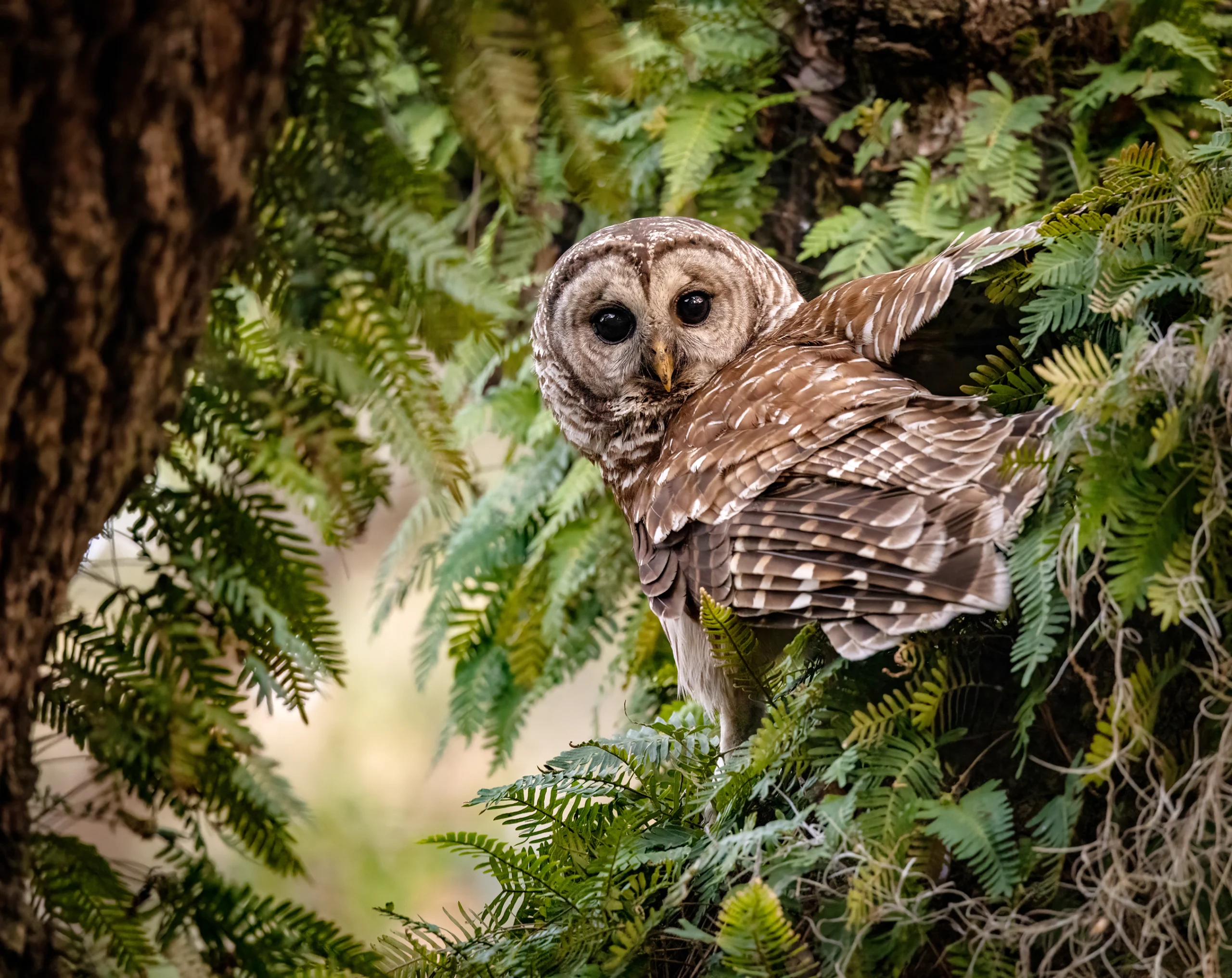
Búho barrado. Foto de Dennis Donohue/Shutterstock
El Búho barrado‘s inimitable “who-cooks-for-you” call is one of the best-known nighttime bird sounds in the U.S. But these hoots are only a small sample of this large raptor’s repertoire. During mating season, Barred Owls engage in raucous duets combining a range of gurgles, caws, hoots, and cackles.
Sin embargo, al cazar, los búhos barrados aprovechan el silencio. La singular estructura de sus plumas, que incluye diminutas dentaduras en las plumas de vuelo, les permite volar prácticamente en silencio. Este vuelo silencioso, sumado a su excelente visión nocturna, los convierte en depredadores excepcionales.
Anteriormente restringidos principalmente a los bosques maduros del este de Norteamérica, estos búhos ahora también habitan grandes extensiones del noroeste del Pacífico. A medida que su área de distribución se ha expandido, también lo ha hecho el número de búhos barrados, que ha crecido un 1,5 % anual durante los últimos 50 años.
Búho barrado (Lance AM Benner, XC500514. Accesible en www.xeno-canto.org/500514.)
Colimbo común

Colimbo común. Foto de Tom Reichner/Shutterstock
Pocos sonidos de pájaros son tan tristes o memorables como el Colimbo común‘s yodel, but that’s not this large bird’s only claim to fame. When darkness falls, Common Loons can frequently be heard producing cackling tremolos and wolf-like wails that are no less haunting.
Las poblaciones de colimbos comunes en el norte de Estados Unidos han disminuido drásticamente debido a la contaminación de las centrales eléctricas de carbón. Águilas calvas y Águilas pescadoras, Los colimbos comunes se alimentan de pescado y reciben la dosis completa de toxinas, como el mercurio, a medida que se acumulan en la cadena alimentaria.
Migrating loons also may be vulnerable to collisions, particularly with wind turbines sited on lakes or other large bodies of water. In December 2019, ABC and partners filed suit in federal court against the U.S. Department of Energy and U.S. Army Corps of Engineers to halt the construction of wind turbines on Lake Erie that could put Common Loons and many other migrating bird species at risk.
Colimbo común (Jelmer Poelstra, XC83547. Accesible en www.xeno-canto.org/83547.)
Búho chillón oriental
Búho chillón oriental. Foto de Imran Ashraf/Shutterstock
Like the Barred Owl, Eastern Screech-Owls produce an impressive array of nighttime sounds. When defending territory, males employ a whinnying call to warn off potential intruders. To communicate, pairs and families will make a cooing tremolo call. While some birds chirping at night repeat the same sounds, Eastern Screech-Owls are different: They can hoot, bark, and, of course, screech.
Aunque el búho chillón oriental todavía se considera una especie común, su población está disminuyendo en algunas zonas. Estos búhos suelen ser víctimas de... collisions with glass and vehicles, and those nesting in suburbs and orchards are vulnerable to pesticidas. As with many other species, habitat loss is a threat in many areas.
ABC Vidrio inteligente para pájaros program offers a number of solutions to protect Eastern Screech-Owls. If you have a wooded yard, you might even consider building a screech-owl nest box.
Búho chillón oriental (Will Sweet, XC453924. Accesible en www.xeno-canto.org/453924.)
Correlimos de las tierras altas

Correlimos de montaña. Foto de Paul Reeves Photography/Shutterstock
The Upland Sandpiper’s ecstatic song bounces over the prairie during spring months when the birds are breeding. The melody, which combines wild trilling with an ethereal whistle, is typically used by males, who vocalize well into the night. Like other birds that sing at night, the Upland Sandpiper is not a nocturnal species and can be spotted during daylight hours.
Aunque las poblaciones de playeros campestres se han mantenido estables en general durante los últimos 50 años, las disminuciones regionales han llevado a casi dos docenas de estados y provincias de EE. UU. y Canadá a clasificar a esta ave como especie de preocupación. Los playeros campestres invernan en Sudamérica cada año y la caza sigue siendo un problema en las rutas migratorias. Sin embargo, la principal amenaza que enfrentan es la pérdida de hábitat, a medida que los pastizales nativos se transforman en tierras de cultivo.
In the United States, ABC is helping Upland Sandpipers and other grassland birds by promoting practices that incentivize sustainable grazing practices and grassland retention, restore formerly cropped lands, and reduce herbicide use. In Mexico, we’re working with local partners to ensure that critical grassland habitat for migrating sandpipers remains firmly protected.
Correlimos de las tierras altas (Paul Marvin, XC299641. Accesible en www.xeno-canto.org/299641.)
Sinsonte del Norte
Sinsonte norteño. Foto de Michael Stubblefield
With the ability to learn nearly 200 different songs, Northern Mockingbirds are veritable avian jukeboxes. These expert mimics find inspiration in the songs of other birds and sometimes rock their tunes around the clock. This happens most often when males are searching for mates, but full moons also get these crooners going.
Aunque los sinsontes del norte siguen siendo comunes en muchas partes de Estados Unidos, su población ha disminuido en más de un 20 % en los últimos 50 años. Este no es su primer declive: durante el siglo XIX, estos cantores eran tan apreciados por sus habilidades musicales que muchos fueron enjaulados, y los sinsontes prácticamente desaparecieron de algunas partes de su área de distribución.
ABC y sus socios apoyan poblaciones saludables de sinsontes del norte mediante Gestión del hábitat en gran parte del área de distribución del ave en Estados Unidos.. Nuestro Gatos en interiores program is also helping to reduce cat-related fatalities, which claim the lives of approximately 2.4 billion birds — including Northern Mockingbirds — each year in the U.S.
Sinsonte del Norte (Omar Suárez García, XC435872. Accesible en www.xeno-canto.org/435872.)