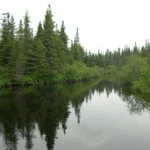
La vida en los bosques templados, ubicados a medio camino entre el ecuador y el Polo Norte o Sur, cambia con las estaciones, y las plantas y los animales han evolucionado para soportar inviernos fríos y nevados, veranos húmedos y calurosos, y todo lo demás. Este es un hábitat valioso para las aves. Los bosques templados sustentan y mantienen a los residentes durante todo el año, a las aves migratorias que anidan y a los visitantes fugaces que se detienen brevemente durante su migración.
Uno de estos visitantes fugaces es la Reinita de Pico Negro. Tras pasar su temporada no reproductiva en los bosques tropicales, esta pequeña ave cantora emprende un largo viaje hacia el norte. Los bosques caducifolios de la zona templada son una parada de descanso para la Reinita de Pico Negro, pero apenas representan la mitad del camino. Tras un día de descanso y la oportunidad de reponer fuerzas, esta migrante de larga distancia emprende de nuevo su camino hacia sus zonas de reproducción en el bosque boreal.
Bosques caducifolios: “Dejadlo atrás”
Los bosques caducifolios estallan en un derroche de color cada otoño en el norte de Estados Unidos, mientras robles, arces, hayas y abedules se preparan para el invierno. Este espectáculo espectacular distingue a los árboles caducifolios: para conservar energía durante el invierno, pierden sus hojas y entran en un período de letargo. En primavera y verano, los cantos de aves migratorias como el... Zorzal de bosque y Reinita cerúlea Mantener a estas especies cantando es el foco del trabajo de ABC en Poconos BirdScape.
ABC’s BirdScapes approach conserves key habitats throughout the annual cycle of target species, ensuring that migratory birds have high-quality habitat on their breeding and non-breeding grounds and at important stopover points in between. Each BirdScape is unique and influenced by local conditions. In the Poconos BirdScape, ABC partners with government agencies, universities, and private landowners to manage forests with the needs of target species such as the Wood Thrush and Cerulean Warbler in mind. Our goal is to ensure that at least 37,000 acres provide optimal habitat conditions for these species. The results have a ripple effect: Once the leaves have fallen and Neotropical migratory birds have flown south, the forest is still teeming with birdlife. Year-round residents like the Urogallo canadiense and Great Horned Owl can brave the winter months in a quality habitat in the Poconos BirdScape.
Bosques de coníferas: árboles construidos para el invierno
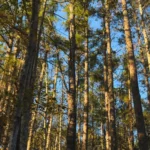
The trees that make up coniferous forests handle the swing of the seasons differently: they have needles rather than leaves and cones instead of flowers. These evergreen trees are adapted for periods of intense cold and snow or prolonged dryness. Jack pine thrives in dry, sandy soils left by retreating glaciers in the Great Lakes region. They may look a bit scraggly, but to the Reinita de Kirtland, they look just right. When it comes to nesting Kirtland’s Warblers, only jack pines will do — and only younger jack pine trees, at that.
Jack pine forests historically experienced periodic natural wildfires that encouraged the growth of new trees by burning and clearing mature trees, with the heat from wildfires releasing seeds from cones. With the suppression of natural wildfire came a precipitous decline in breeding habitat for Kirtland’s Warblers. Careful management of jack pine forests, including the use of managed burns and timber harvests, helped restore the habitat and reverse the freefall of the Kirtland’s Warbler population. Though they may lack the showy display of a deciduous forest, coniferous forests are every bit as active — and vital.
“La casi extinción de la Reinita de Kirtland debido a la pérdida de hábitat fue una experiencia de aprendizaje para los conservacionistas”, dijo Steve Roels, Director del Programa de Reinitas de Kirtland y Coordinador del Equipo de Conservación del ABC. “Simplemente designar grandes áreas boscosas como hábitat protegido fue insuficiente, ya que la Reinita de Kirtland, al igual que otras especies jóvenes especialistas en bosques, necesita además una estructura forestal adecuada dentro de esos grandes bloques de hábitat”.”
ABC y sus socios están trabajando para conservar al menos 36.000 acres para la Reinita de Kirtland y otras especies que comparten su hábitat especializado.
Bosques templados lluviosos: bosques lluviosos con áreas de distribución
While they experience seasons and are cooler than their tropical counterparts, temperate rainforests also have continuous canopy cover, with trees like the soaring Sitka spruce, Douglas fir, and western hemlock rising along the western coasts of the northern United States and Canada. In Chile and Argentina, the Valdivian forests that remain as a thin strip along the coast are made up of incredibly long-lived trees like the ancient alcerce. Fieles a su nombre, las selvas tropicales templadas experimentan un alto nivel de precipitaciones y algunas zonas de las selvas tropicales del Pacífico reciben hasta 3 metros de lluvia al año.
En estos bosques húmedos y musgosos del noroeste del Pacífico, es posible que tenga la suerte de ver a la especie en peligro de extinción mérgulo jaspeado, Una diminuta ave marina con una inusual dependencia de los árboles. Esta ave, del tamaño de una codorniz, parece estar bien adaptada a la vida acuática y usa sus alas cortas y romas como timones para sumergirse hasta 50 metros en el mar. Sorprendentemente, estas alas rechonchas también le permiten volar hasta 80 kilómetros tierra adentro para anidar, a menudo en los altos árboles de las selvas templadas costeras. ¡Las apariencias engañan! Los hábitos de anidación de los mérgulos jaspeados, a grandes alturas, siguieron siendo un misterio hasta bien entrada la década de 1970.
Along with wildfire, the logging of old-growth forests remains one of the most concerning threats to the species. Unlike the cyclical fire that is needed to make way for new jack pines to grow, wildfires in the temperate rainforest are rare and often catastrophic events, caused by human acts or random events like lightning strikes. A lesser-known threat is nest predation by corvids, such as the Common Raven, which are attracted to nesting areas by the availability of food at nearby campsites. Through the Crumb Clean campaign, ABC y sus socios están trabajando para mantener estos hábitats forestales libres de desperdicios de alimentos y más seguros para los mérgulos que anidan.