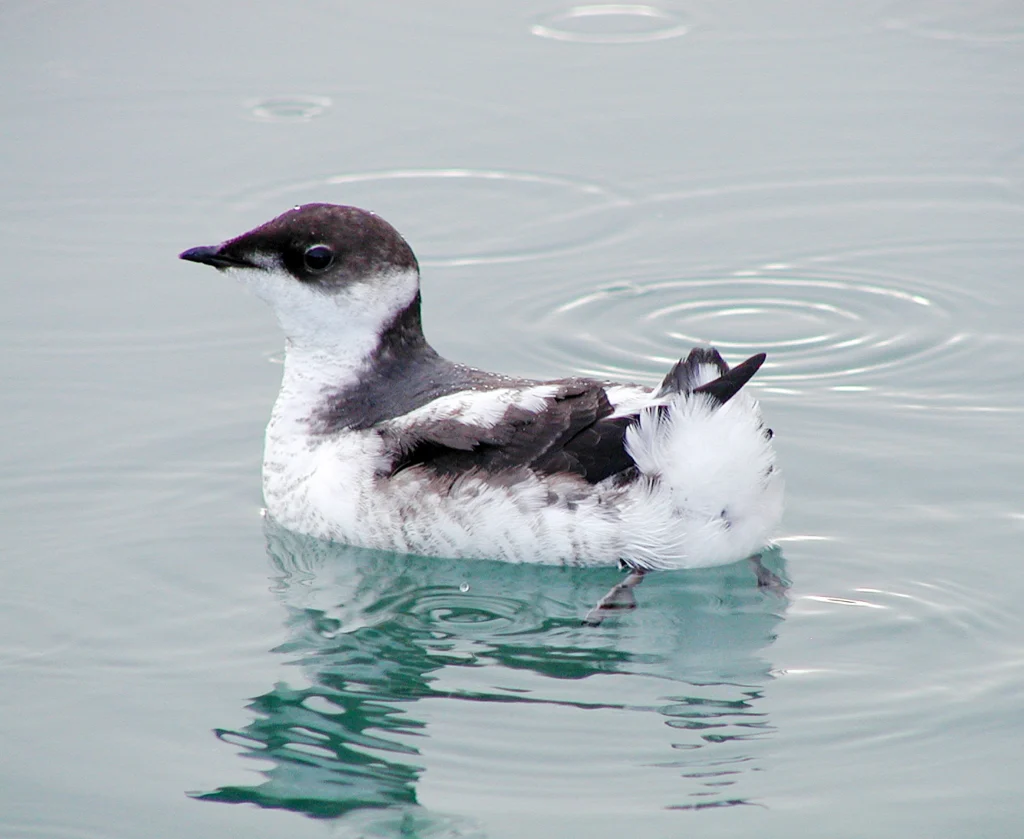
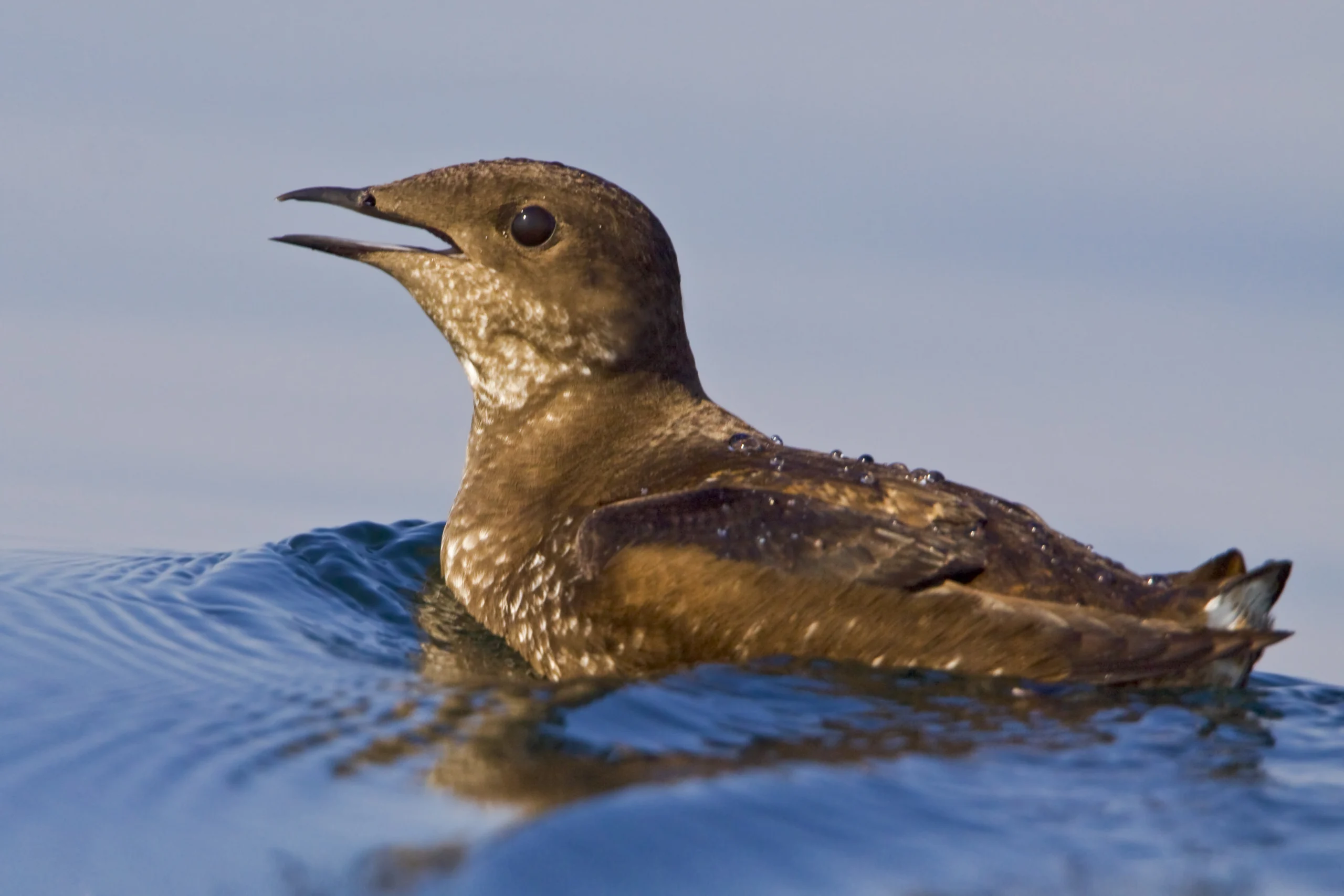
Marbled Murrelet (Brachyramphus perdix) swimming in the ocean in Victoria, BC, Canada.

Conserving Marbled Murrelets

Taking Action for a Forest-Nesting Seabird

Marbled Murrelet. Photo by Glenn Bartley.

Conserving Marbled Murrelets

Read in English
Actualizaciones del proyecto
Escuchar este articulo

El mérgulo jaspeado has a “wing” in two worlds. The murrelet is first and foremost a seabird, often spotted foraging near shorelines along the Pacific Coast. Above water, the murrelet bobs along in the waves, its head held high and its stubby tail pointing skyward. But when the need to forage strikes, it bolts below the surface, making a quick descent using open wings and rapidly kicking feet to “fly” through the water in pursuit of sardines and smelt, codfish and capelin. Clearly, the Marbled Murrelet is built for water.

But the murrelet is also a bird of the forest, and old-growth forests located in northern California, Oregon, and Washington in particular. Where these little seabirds bred stumped scientists for years. It wasn’t until the 1970s that the first Marbled Murrelet nest was discovered: a few miles inland, murrelets make their nests high up in the generous, mossy limbs of ancient Douglas-firs, hemlocks, redcedars, spruces, and redwoods. The tiny seabird, it turns out, is also a forest bird.

This revelation has major implications for conserving the Marbled Murrelet, whose population has declined by more than half in the past 50 years. Birds need conservation through the entirety of their annual cycles, which means, for the murrelet, at sea and in sky-high trees on land.

At sea, populations have suffered direct and indirect effects of depleted prey species from oil spills and pollution. Bycatch — the scourge of seabirds — also claims the lives of murrelets when they become entangled in commercial fishing nets and drown. And on land, the loss of old-growth forests to logging, development, and wildfire have removed suitable nesting trees from the landscape, and fragmentation of these forests opens up nesting Marbled Murrelets to the threat of increased predation by clever, opportunistic corvids, the jays, crows, and ravens.

Marbled Murrelet populations in Washington, Oregon, and California are listed as Threatened under the federal Endangered Species Act. All three states recognize the species as Endangered under their own endangered species laws.

American Bird Conservancy (ABC) goes where the murrelets go, partnering with state and federal agencies, conservation organizations, and researchers to conserve the species across its life cycle, on land and at sea, from forest stands to the hallways of Congress.
Crumb Clean: Safer Nesting Sites for Marbled Murrelets

Corvids are highly intelligent, crafty, and resourceful, and they have an “everything-but-the-kitchen-sink” approach to food. They have followed the figurative (sometimes literal) trail of granola bars, fruit, jerky, and other delicacies left by forest trekkers. The promise of discarded campsite dinners tossed in open trash cans brings jays, crows, and ravens to places they normally would be scarce, and the easy access encourages them to linger.

This puts them in proximity to vulnerable eggs and murrelet chicks. Corvids naturally prey on nests, but having so many of them so close increases the chance of predation. Murrelets rely on the structure of the forest to stay safe while incubating eggs and to protect their young. After they hatch, murrelet chicks remain in the nest alone for several weeks until they fledge, with the parents flying between sea and forest to catch and deliver food. The problem is so severe that corvids are among the leading causes of nest failure for Marbled Murrelets, which raise only one chick each breeding season.

ABC has led the expansion of a campsite clean-up program known as “Crumb Clean” into Oregon and Washington. A similar campaign launched in 2013 by California State Parks substantially reduced the presence of Steller’s Jays by offering campers education and improving waste disposal. Wildlife-proof garbage cans, food lockers, and dishwashing stations cut down on a quick, easy meal for the corvids, which seek out more fruitful foraging elsewhere.

Fighting for Old-Growth Forests

The Marbled Murrelet has become an unlikely posterbird for the towering old-growth forests of the Pacific Northwest, though its connection to these forests is still not well understood. It wasn’t until the mid-1970s that a Marbled Murrelet nest was first documented, and their nests remain incredibly challenging to spot. While researchers are still learning about the murrelet’s nesting habits, one thing that is very clear is the species’ dependency on forests.

It’s not just murrelets and other wildlife that need forests: Humans do, too. Forests are sources of clean drinking water and store carbon. They provide materials essential to everyday living, everything from timber for construction to pulp for diapers, as well as jobs. Old-growth forests in the Pacific Northwest were heavily logged from the 1950s until the mid-1990s.

ABC has advocated for strengthening the Northwest Forest Plan (NWFP), a suite of federal policies and guidelines for the management of federally owned lands in California, Oregon, and Washington. The NWFP was adopted in 1994 in response to the extensive logging that had a severe impact on the Northern Spotted Owl. At the center of the NWFP was achieving a balanced, science-based approach to protecting the health of the region’s ecosystems while allowing for timber sales at sustainable levels.

Unfortunately, the NWFP has been gradually weakened, despite strong evidence that the plan works, and now the Bureau of Land Management is proposing aggressive old growth logging in the murrelet habitat it manages on the public lands system in Oregon. ABC has been at the forefront of the effort to push back against attempts to open ancient forests to unsustainable logging. A strong NWFP would not only conserve the acreage murrelets and other species need but also reduce the fragmentation of forest habitat. It’s not simply habitat loss that puts the Marbled Murrelet at risk. Its nests suffer heavier predation in smaller areas where forests remain.

A juvenile Marbled Murrelet. Rich MacIntosh/USFWS.
A juvenile Marbled Murrelet. Photo by Rich MacIntosh/USFWS.

Advocating for Conservation Resources

El Ley de Especies en Peligro de Extinción (ESA) was signed into law in 1973, around the same time that a Marbled Murrelet nest was first discovered and documented. It would be close to two decades before the Marbled Murrelet would be added to the endangered species list. The ESA has a 99 percent success rate when it comes to preventing extinction, and with listing comes protections and considerations that would otherwise be lacking. Habitat identified as critical to the murrelet’s recovery cannot be modified without first undergoing thorough consultation with the U.S. Fish and Wildlife Service, for example.

ABC continues to advocate for stronger support for Marbled Murrelet conservation through uplisting the species from Threatened to Endangered. At the state level, ABC successfully encouraged the reassessment of the bird’s status in Oregon in 2021.

Large-scale conservation actions are almost always contingent on adequate funding, and ABC is committed to making sure Marbled Murrelets and other threatened birds have a seat at the table when funding decisions are being made. This includes advocating at the federal level for increased support for Marbled Murrelet recovery efforts and working with states to develop innovative approaches to funding conservation work. In Oregon, ABC strongly supported a 2026 law that will generate as much as $30 million per year to help struggling species recover in the state.

Ensuring Safer Seas

Every year, hundreds of thousands of seabirds are the unfortunate victims of bycatch when they become hooked on longlines or ensnared in fishing nets. Gillnets, wide fishing nets that hang vertically in the water like a curtain, claim the lives of thousands of Marbled Murrelets annually in the species’ northern range in Alaska. ABC works with fisheries and maritime communities throughout the Americas to encourage the adoption of safer fishing techniques that reduce the risk of bycatch, and works to address overfishing to keep prey plentiful for species like the Marbled Murrelet.

Marbled Murrelets are especially vulnerable to oil spills because of their tendency to forage close to shore, where spilled oil concentrates, swept in on waves and by wind. Oiling can kill murrelets directly, and their small size makes them less likely than larger-bodied birds to be recovered following an oil spill. And oiling can have longer-term, widespread impacts on entire populations, including extirpation from parts of their range and reduced rates of reproduction.

A Future for the “Fog Lark”

For many years, loggers working in the Pacific Northwest took to calling the Marbled Murrelet the “fog lark.” They could hear their frequent, sharp keeer notes, used by murrelets to stay in contact with one another, but they couldn’t identify their source within the foggy forest or along the misty shores.

“Foggy” might be an apt description of much more than the habitat of the Marbled Murrelet. Of all of North America’s breeding birds’ nests, the murrelet’s was among the very last to be discovered. There is still much to learn about the birds’ lives at sea or how nesting trees are chosen. Researchers are still uncovering these and other aspects of their life history that will make efforts to conserve the murrelet more impactful.

The outlook of the bird’s future is foggy, too. Its population is estimated to include no more than 280,000 birds, and it has declined by more than half in the past 50 years. But ABC is committed to reversing the fortunes of this unique and enigmatic species, and experience and time have revealed a clearer path to the Marbled Murrelet’s recovery: advocacy to ensure the persistence of the old-growth forests murrelets and so many other species need, and on-the-ground education and public engagement to reduce the threat of nest predation.